AI Coding Assistant Guardrails For Production Teams
AI coding assistant guardrails prevent architectural drift and unsafe defaults. Here is what makes one actually effective, and how context engineering fits in.
3 min read
Guardrails need teeth
A guardrail is only useful if it can reject a bad output. Style guidance helps readability, but a production AI coding assistant workflow needs rules that can actually stop incorrect architecture from entering the codebase — not just discourage it.
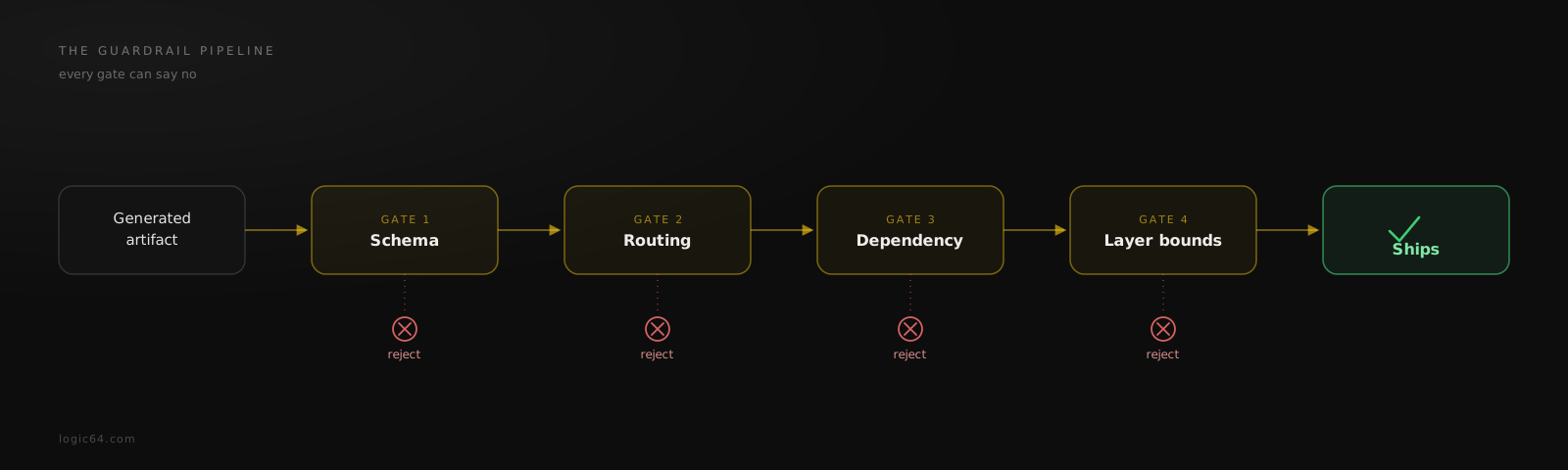
Concretely, that means things like schema validation, fixed routing matrices, dependency approval, and explicit boundaries between frontend, backend, engine, and CLI code — each one a check that can say no, not a suggestion the assistant is free to skip.
This is context engineering, not prompt engineering
Prompt engineering is about wording a single request well. Context engineering is a different discipline entirely: deliberately designing what information a model has access to in the first place — the architecture, the rules, the prior decisions — so that even an ordinary prompt has correct material to work from.
A guardrail is context engineering with a rejection path. It does not just give the assistant better information — it can also say no when the output contradicts that information.
This reframes what a knowledge tree like docs/okf/ is actually doing. It is not documentation that happens to also be readable by an AI assistant — it is the engineered context a governed workflow gives that assistant instead of asking it to infer the same information from a conversation.
What a concrete guardrail actually looks like
- Schema validation — a generated file has to match a defined shape, or it does not ship.
- A fixed routing matrix — this kind of file always goes to this destination, never inferred per request.
- Dependency approval — new libraries are compared against an explicit allow/deny list, not accepted on the model's judgment.
- Layer boundaries — frontend code cannot reach into backend internals, and vice versa, enforced by a check, not a comment.
Keep rules local and reviewable
Team rules should live in the repository, where both humans and AI assistants can read them. If rules only exist in memory or chat history, they will drift the moment that conversation ends — the next session, or the next teammate, starts from zero.
Reviewable governance files also make changes intentional. A team can discuss a rule change in a pull request, instead of discovering it after generated code has already moved the system in a new direction.
Tie guardrails to delivery, not cleanup
The strongest guardrails run before delivery. They check generated artifacts before packaging, deployment, or local installation — not after, as a cleanup pass once something has already gone wrong. Logic64 treats validation as part of generation itself, not a task that happens once the damage is already done.
A minimal guardrail set for a production team
This applies whether or not you use Logic64. A production team adopting an AI coding assistant should, at minimum:
- Put the architecture and rules in files the assistant reads automatically — not in a chat history nobody can search.
- Give the assistant a schema or contract to check its own output against, not just a style guide.
- Enforce a routing matrix for where generated files land — never leave destination to inference.
- Run every check before the output ships, not after it is already merged.
Frequently asked questions
What is the difference between context engineering and prompt engineering?
Prompt engineering is about wording a single request well. Context engineering is about deliberately designing what information a model has access to at all — the architecture, the rules, the prior decisions — so a well-worded prompt has correct material to work from in the first place.
What makes an AI coding guardrail actually effective?
It can reject a bad output, not just discourage it. A guardrail with no enforcement — a style suggestion, a comment asking the assistant to "be careful" — is guidance, not a guardrail. An effective one is a schema check, a routing rule, or a compliance scan that can mechanically stop a bad file from shipping.
Where should AI coding assistant rules live?
In the repository, as files both humans and the assistant can read — not in chat history or a team member's memory. Rules that only exist in a conversation drift the moment that conversation ends.
Related reading