Logic64 vs Raw Prompting
Logic64 differs from raw prompting by locking architecture, validating generated output, and packaging a governed workspace — here is exactly where.
2 min read
What raw prompting actually is
Raw prompting means asking an AI coding assistant to build something directly, with no planning layer in front of it. The model has to infer whatever the prompt did not specify — the data model, the service boundaries, the auth pattern — and it will, because it has to produce something.
That can work well. For small scripts, demos, and isolated components, letting the model choose reasonable defaults is often the fastest path to a working result. The trouble is that "reasonable" and "correct for your product" are not the same thing, and raw prompting has no mechanism to tell them apart.
Where it breaks down at scale
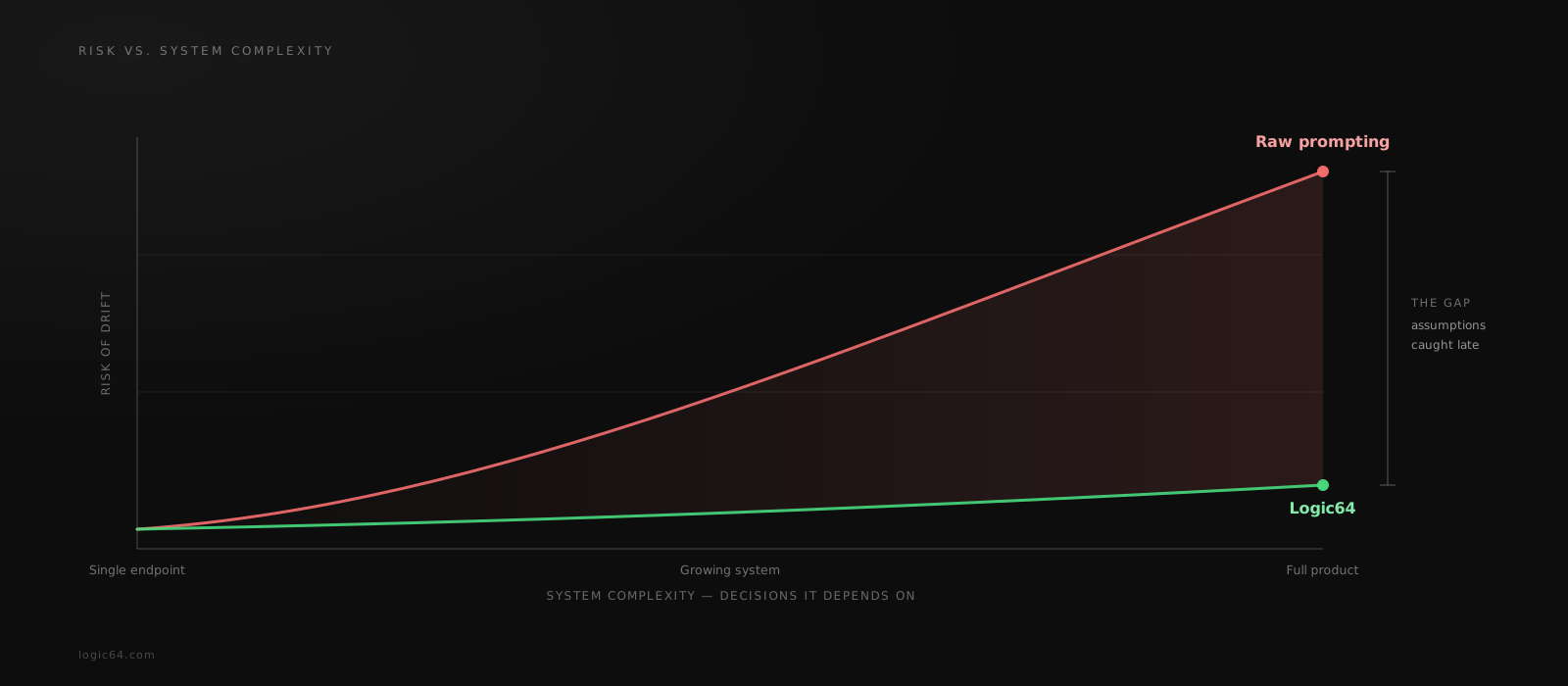
The risk grows with the number of decisions a system depends on. A single endpoint has few enough moving parts that an assistant's default choices rarely matter. A real product — services, security boundaries, persistent state, deployment constraints — has enough of them that two different prompting sessions will quietly assume different things about the same system.
None of that shows up as an error. The code compiles. It runs. The disagreement only surfaces later, usually as a bug that traces back to two components that were never actually designed to agree with each other.
What Logic64 changes
Logic64 starts with governed planning instead of an open prompt. The stack and boundaries are made explicit and locked — an Architecture Lock — before generation happens at all. Only then does the engine produce the governed workspace: the docs/okf/ knowledge tree, the CLAUDE.md / AGENTS.md / GEMINI.md adapters, MCP configuration, and a tasks.md build contract.
That output is checked against the locked decisions before it is handed off, not trusted on sight. The model still writes useful code — it operates inside a contract instead of inventing the contract as it goes.
Side by side
| Raw prompting | Logic64 | |
|---|---|---|
| Who decides the architecture | The model, inferred from the prompt | You, in Plan — locked before Build |
| When a wrong assumption is caught | Later, usually as a bug | At validation, before handoff |
| What you get at the end | Generated code in a chat session | A governed workspace, pulled locally |
| Best fit | Scripts, demos, low-stakes prototypes | Anything that becomes the real system |
Choose by risk level
Use raw prompting when the cost of a wrong assumption is close to zero. Use a governed workflow when the output needs to become the foundation of something you will maintain. Architecture-first generation is slower up front than a single prompt — that time is spent once, instead of repeatedly, as rework every time a silent assumption turns out to be wrong.
Frequently asked questions
Is Logic64 just a prompt wrapper around an AI coding assistant?
No. A prompt wrapper still lets the model infer architecture as it goes. Logic64 separates planning from generation entirely: architecture gets locked first, then the workspace is generated against that lock and validated before it is handed off — a different workflow shape, not a different prompt.
Can I still use raw prompting with Logic64?
Yes, and that is the intended use once a workspace exists. Local AI coding tools work inside the governed structure Logic64 generates — narrow, concrete prompts against known boundaries, not open-ended requests to design the system.
When should I skip Logic64 and just prompt directly?
For a script, a demo, a spike, or anything where a wrong architectural assumption costs you nothing. Raw prompting is faster for that. Logic64 earns its cost once the output is meant to become a real, maintained system.
Related reading