CLAUDE.md vs Skills: What Goes Where
CLAUDE.md is always-on project context; a Skill is an on-demand capability. Here is exactly where each one belongs, and where Logic64 fits.
2 min read
What CLAUDE.md is
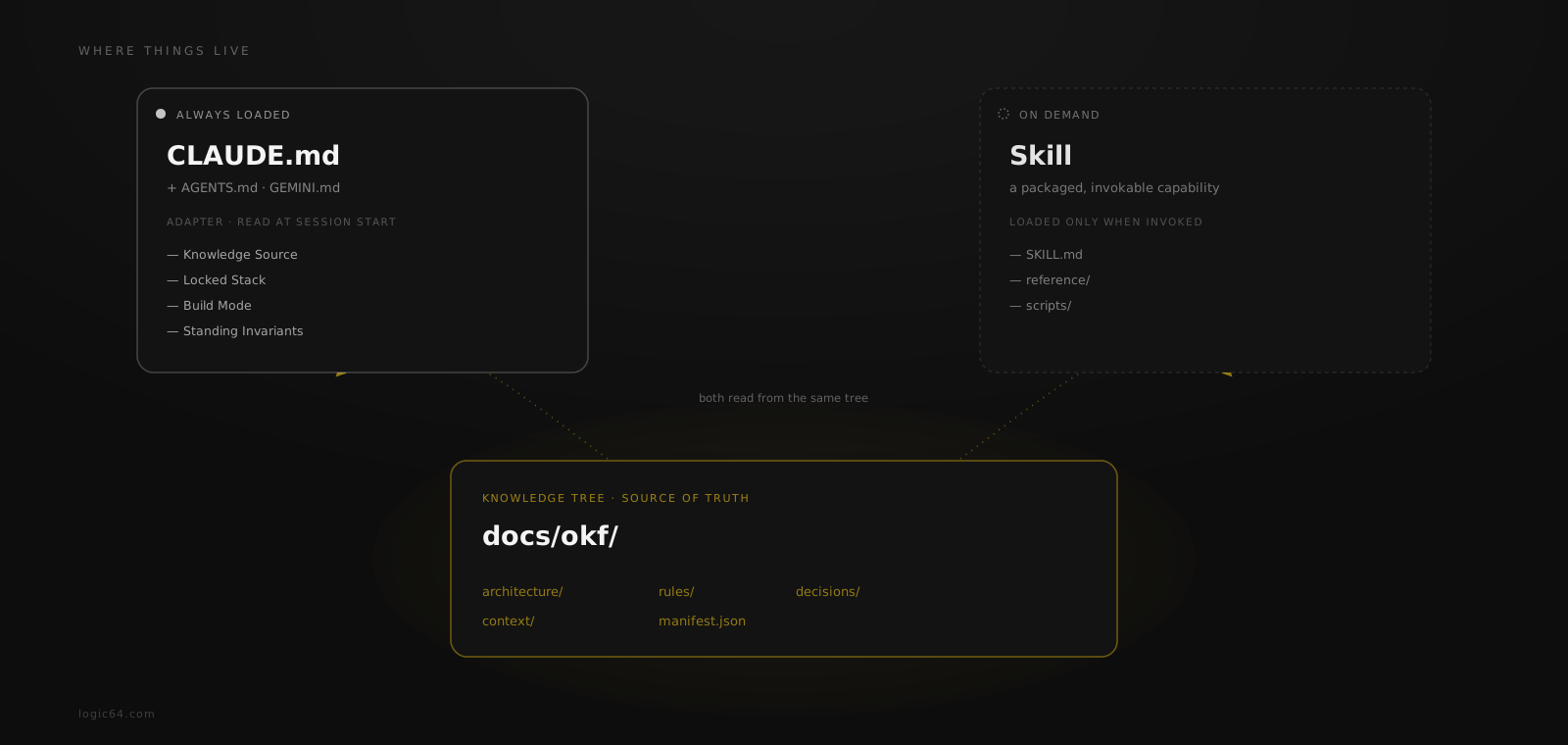
CLAUDE.md is a governance adapter: a short file at the project root that Claude Code reads automatically at the start of every session. It carries the standing rules for the project — the locked stack, what is out of bounds, when a change needs approval — and it applies to every task, whether the session is fixing a typo or building a new service.
Because it loads every time, it has to stay small. The moment it starts accumulating specialized procedures for individual tasks, it stops being fast, general context and starts being a slow, bloated file the assistant has to wade through before doing anything.
What a Skill is
A Skill is the opposite shape: a packaged, task-scoped capability that Claude Code loads only when a specific job calls for it — not on every session. Where CLAUDE.md answers "how should you behave here, generally," a Skill answers "here is exactly how to do this one specific thing, in depth."
That makes Skills the right home for anything that is detailed but situational: a multi-step migration procedure, a specialized review checklist, a deep how-to for a particular framework or workflow. None of that needs to load for a session that never touches it.
The core difference: always-on vs on-demand
| CLAUDE.md | A Skill | |
|---|---|---|
| When it loads | Every session, automatically | Only when a matching task calls for it |
| What it should hold | Standing rules, locked stack, approval boundaries | A specific, repeatable procedure or capability |
| Right size | Short — it is a cost paid on every session | As long as the task actually needs |
| Wrong use | A dumping ground for every past decision | A restatement of general project rules |
If a rule applies to literally everything, it belongs in CLAUDE.md. If it only matters for one specific kind of task, it belongs in a Skill — loading it for unrelated sessions only adds cost with no benefit.
When to use which
- A rule that never changes based on the task — put it in CLAUDE.md.
- A procedure you only need for a specific, recurring job — put it in a Skill.
- Something that would make CLAUDE.md longer without applying to most sessions — that is almost always a Skill in disguise.
- A restatement of what CLAUDE.md already says — that is not a Skill, it is duplication, and it will drift the moment one of the two copies gets edited.
Where Logic64 fits
Logic64 generates the always-on layer directly from your locked architecture: the docs/okf/ knowledge tree, and the CLAUDE.md / AGENTS.md / GEMINI.md adapters that route each assistant into it. It also generates per-project specialist files under .claude/agents/, derived from the stack you locked — a devops specialist when your infrastructure decisions call for one, for example.
What it does not do is author custom Skills on your behalf. Skills are a Claude Code platform feature for packaging your own specific, repeatable procedures — they sit on top of the governed workspace Logic64 generates, not inside it.
Frequently asked questions
Is CLAUDE.md the same thing as a Skill?
No. CLAUDE.md is read automatically at the start of every session — it is always-on project context. A Skill is loaded only when a specific task calls for it — it is on-demand, task-scoped capability. They solve different problems and are not interchangeable.
When should I write a Skill instead of adding to CLAUDE.md?
When the thing you are capturing is a specific, repeatable procedure — a multi-step workflow, a specialized capability — rather than a standing rule about how to behave in the project. If it only matters for one kind of task, it belongs in a Skill, not in the file that loads on every single session.
Does Logic64 generate Skills for my project?
No, and it would be inaccurate to claim otherwise. Logic64 generates the always-on governance layer — the docs/okf/ knowledge tree and the CLAUDE.md / AGENTS.md / GEMINI.md adapters — plus per-project specialist files under .claude/agents/, derived from your locked stack. Custom Skills are a Claude Code platform feature you add separately, on top of that governed workspace.
Can I use CLAUDE.md and Skills together?
Yes — they are meant to be used together, not chosen between. CLAUDE.md gives every session the standing rules and locked stack; Skills give specific tasks a deeper, specialized procedure to follow when one is needed. Neither replaces the other.
Related reading